The Misconceptions about Jonathan Gannon's and Nick Rallis' Defense

By Walter Mitchell
The main questions about Jonathan Gannon's and Nikc Rallis' defense right from the start are:
1. What good are creative schemes if they don't work?
2. What kind of a chance does a "caution and cushion" defensive philosophy and scheme that employs a heavy use of passive zone coverages have to succeed in today's NFL?
3. What kind of a chance does an NFL defense have when the defensive coaches show game after game little ability to make adjustments --- both during the week in game preps --- and. most importantly, during games when the opposing offense is exploiting their defense left and right, all game long?
4. What good is it for the Cardinals' defense to be #1 in coverage disguises when opposing WRs, TEs and RBs are left consistently wide open?
Have a close read of Cody Alexander's analysis of the Cardinals' 2025 defense.
Note: my reactions to each part of the article are in bold italics.
Build a 3-4: Arizona Cardinals Defense Schematic Analysis (matchquarters.com)
Schematic Survival: Protecting an Overmatched Front with a Positionless Secondary
A technical deep-dive into the "Build a 3-4" mechanics and how Arizona uses "Passive Pressure" to manufacture box integrity with sub-package personnel.

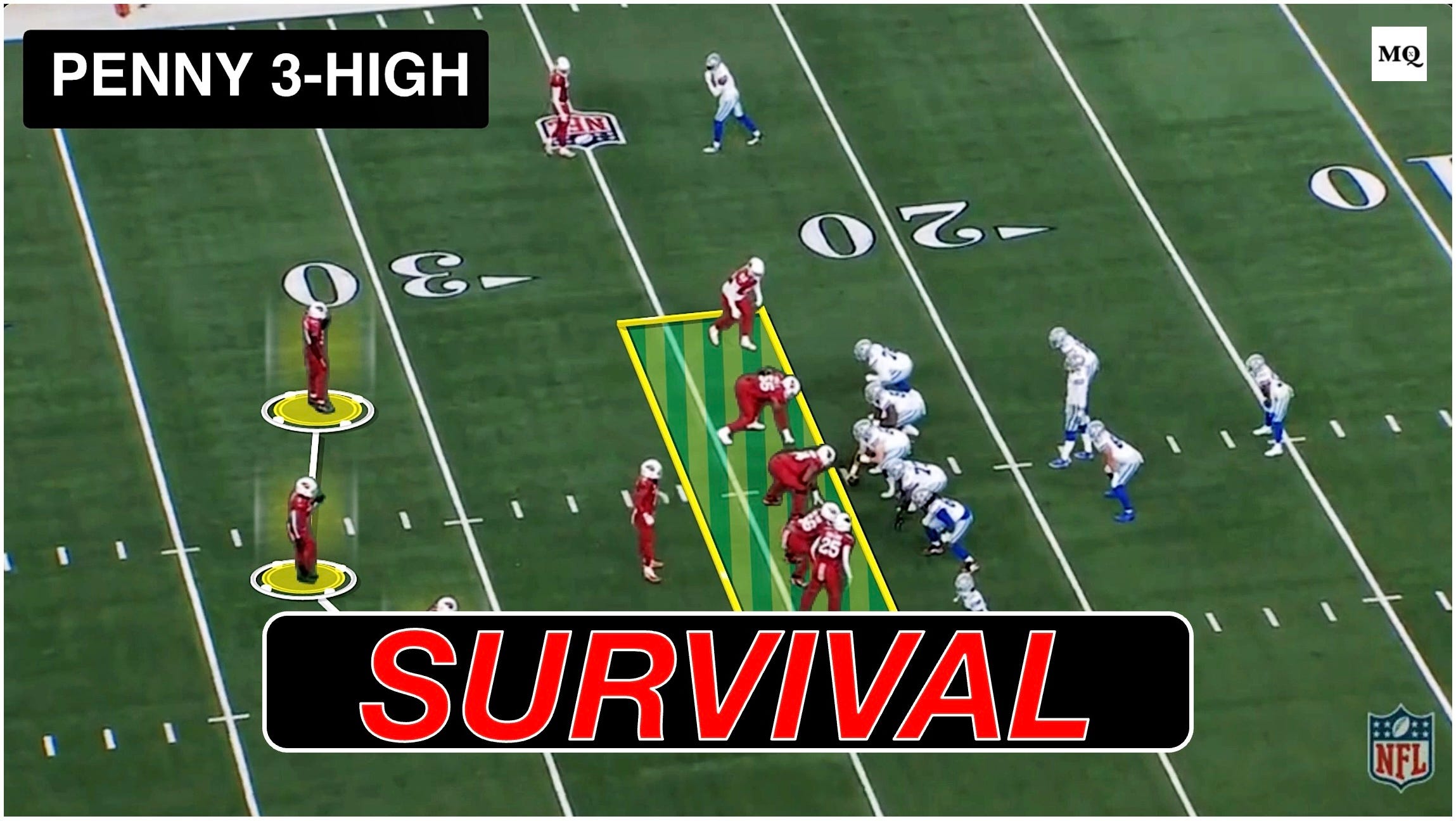
Arizona’s defense is an exercise in “schematic survival.” By pairing a positionless secondary with an outmatched front, Nick Rallis has built a system that relies on “passive pressure” (mental) rather than physical dominance. Being schematically unique is not something many defenses strive for in the NFL, but in Arizona, it wasn’t an option.
Outmatched front?
SOLB Zaven Collins - 2 years / $14M
SDE Calais Campbell - 1 year $6M, plus $1.5M in incentives
NT Dalvin Tomlinson -2 years / $29M
WDE Darius Robinson - 4 years / $13.9M
WOLB Josh Sweat - 4 years / $76.4M
Average yearly salaries total: $51M
Rallis' defense relies on "passive pressure" rather than "physical dominance"?
This is "schematically unique" because it wouldn't work in Pop Warner.
You say that the "passive pressure" is "mental." Then, why would it come as a surprise that Rallis' passive defense was the worst tackling team in the NFL? And that it would be difficult to find a defense that gives up so many wide-open passes, most embarrassingly so in the red zone?
Rallis' problems aren't for lack of physical talents, they are for:
1. Lack of motivation.
2. Misunderstanding of positional prototypes at ILB, ED, CB, slot CB.
3. Poor game preps.
4. No evidence of effective weekly and in-game adjustments.
5. Chronic lack of player development, particular of the team's draft picks.
6. Losing the players' trust.
The league is notoriously close-knit and copycat. Though the Jonathan Gannon era ultimately wasn't a success, it provided the league with one of the best examples of innovation born of desperation (i.e., a lack of talent).
What good is innovation when the results consistently fail?
Most pundits and fans alike were a little shocked that the organization retained Nick Rallis. Arizona interviewed multiple candidates, including Gus Bradley (former Colts DC), Aubrey Pleasant (former Rams PGC), Dino Vasso (DBs/Texans), and Karl Scott (Seahawks PGC)
Shocked? Michael Bidwill is already paying millions of dollars to Kliff Kingsbury to be assistant head coach of the Rams, Jonathan Gannon to be DC of the Packers and Kyler Murray to be a QB for the Vikings on a vet minimum salary. Nick Rallis was still under contract, and he was reporting to work every day while Mike LaFleur was trying to hire his staff and was being encouraged to keep holdover coaches like Nick Rallis, OLC Justin Frye and a few others --- which is a rite of passage for Bidwill's newest 1st time head coach appointees. You know the old quid pro quo!
None of the names listed were ultimately hired, with Bradley, according to SI’s Albert Breer, choosing “to go to Tennessee with Saleh, despite a richer financial offer and the opportunity to call plays in Arizona.” Scott, another high-profile candidate within the division, also turned down the opportunity, returning to Seattle.
Ultimately, outside of Bradley, no candidate had actually called plays in the NFL. ESPN’s Jeremy Fowler tweeted about Rallis’ retainment, explaining, “[Arizona] wanted playcalling experience. Rallis brings that and continuity.”
What's the point of play calling experience when the philosophy of the defense is so flawed?
Innovation Born of Desperation
There were high hopes in the desert for much-needed defensive improvements within the NFL’s most unique defense. Edge Josh Sweat was acquired from the Eagles, along with Dalvin Tomlinson (Browns), and the ageless Calais Campbell (Dolphins), to assist in the growth of 1st Round draft picks Walter Nolan III (‘25) and Darius Robinson (‘24).
In the backend, Will Johnson was scooped up on the 2nd Round; a player that many had as a 1st Round prospect. All things were pointing north for a defense that was in serious need of a talent injection. Then the injury bug took a massive bite out of the roster.
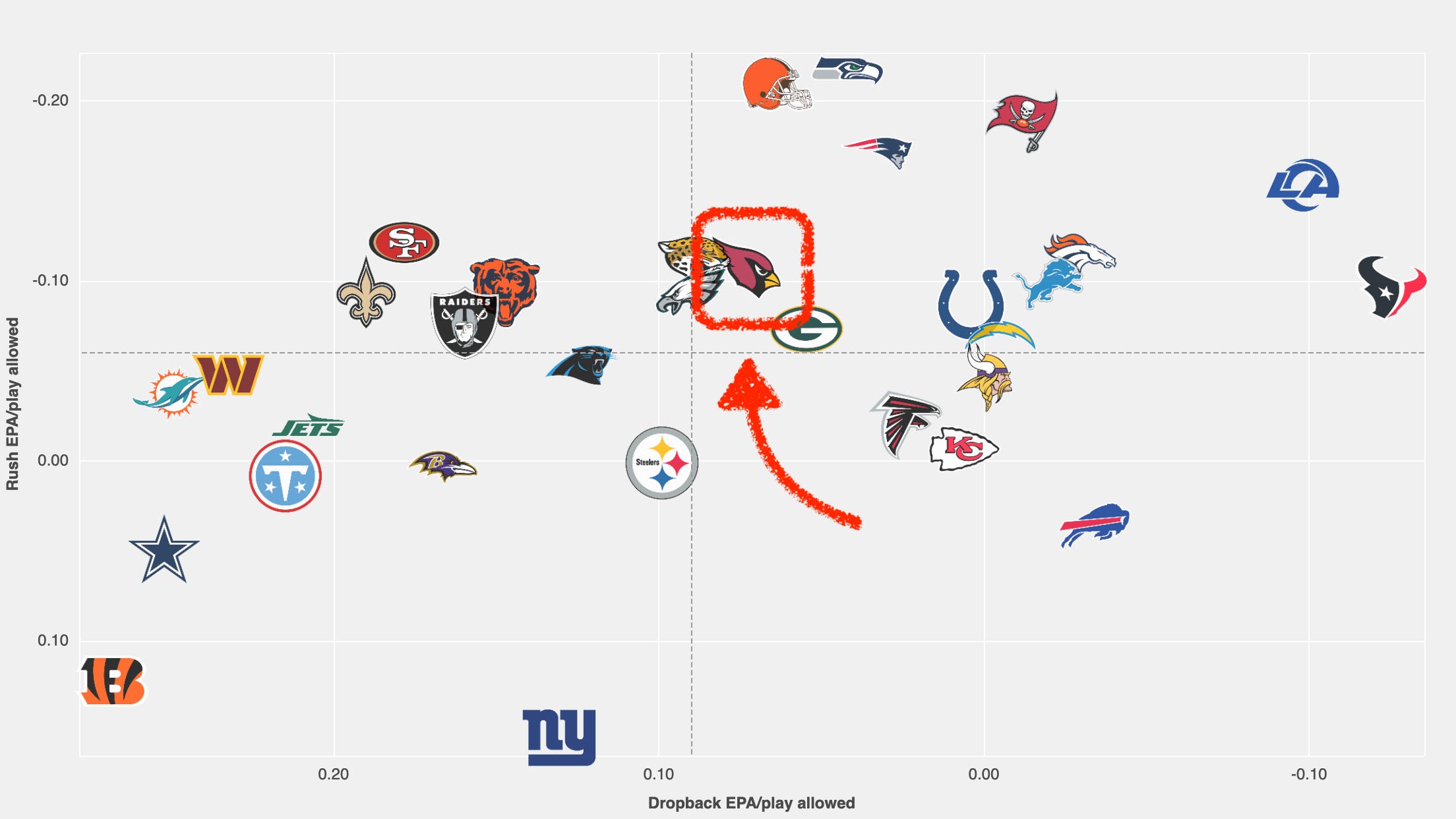
Nolan, the draft class's centerpiece, started and ended the year on IR. In the secondary, Nickel Garrett Williams and CB Starling Thomas were out from the start. Even with a disjointed beginning to the season, the Cardinals were holding steady as the 16th-best defense in EPA and the ninth-best run EPA.
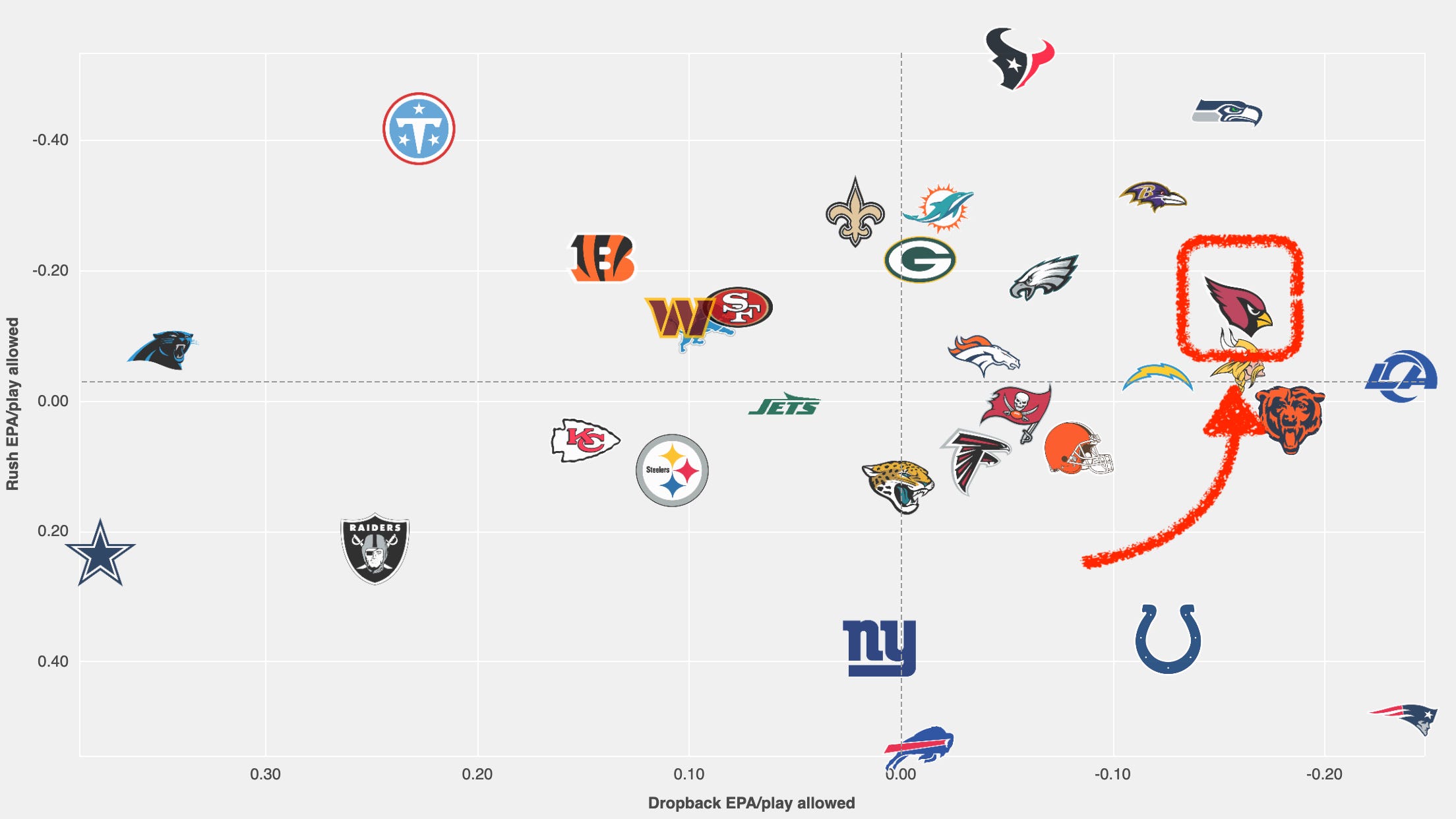
But by Week 8, Arizona was 2-5. They’d win one more game, Week 10 versus the Cowboys, and sputter to an 0-9 finish. Both sides of the ball played poorly, but Rallis stabilized the defense at times with his unique scheme, especially on 3rd downs before Budda Baker was injured late in the season.
Both sides of the ball did not play poorly. The Cardinals' offense finished 7th in passing and 9th in 3rd down conversion percentages. Over Jacoby Brissett's 12 starts, he put up the most passing yards per game at 280.5 and the second most TD passes of 23, second only to Matthew Stafford. The Cardinals' offense played hard and aggressively --- whereas the passive Cardinals' defense after 10 games virtually threw in the towel and even worse, looked like they had lost the love for the game.
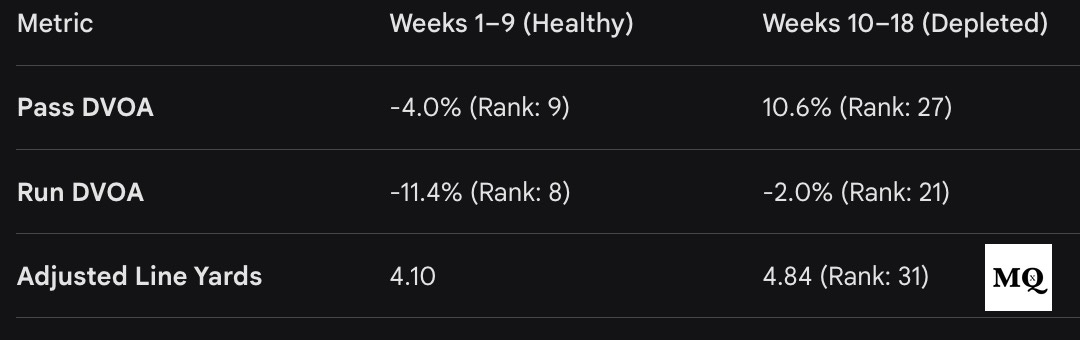
Rallis ultimately had to protect a young CB room and win consistently with an outmached front. For the Cardinals, this was nothing new and exactly what the defense’s design was built to handle. Arizona’s strength comes from its “positionless” secondary, in Baker, Jalen Thompson (Cowboys), and Dadrion Taylor-Demerson.
Depleted defense?
The only staters from Week 1 to not start Week 18 were Mack Wilson Sr. and Garrett Williams. Yes, even when they were playing this season:
* Mack Wilson Sr.: 99th LB overall, 141st LB tackling, 77th LB coverage * Garrett Williams: 90th CB overall, 189th CB tackling; 78th CB coverage.
The Problem: How do you maintain box integrity against heavy personnel when your front is outmatched, and your best players are in the secondary?
The Cardinals' best players were up front (Collins, Campbell, Tomlinson, Sweat), not in the secondary. They were being coached by a 1st year DL coach with no NFL experience and a DC whose incompetent HC wouldn't hire any veteran assistants or advisors to give Rallis the much needed help he required. How were veteran players supposed to take the coaching staff seriously when it completely lacked the experience and gravitas?
The Solution: Below, I dive into the technical mechanics of Arizona’s “Build a 3-4” concept. I break down the safety rotations and post-snap structures that allowed Nick Rallis to stabilize a “light” defense on early downs (and before injuries), while ranking #1 in coverage disguise.
Again, what good is it to have the NFL's #1 defense in coverage disguises when the unit consistently left WRs, TEs and RBs uncovered?
Case in point. In a key road game at Minnesota on 4th and 7 ahead of the Vikings 22-16 and under 2 minutes left in the game, Nick Rallis called a disguised blitz for the ILB where the edge was asked to fill the ILB's zone by running to the middle of the field. As that was happening, from the slot, All-Pro WR Justin Jefferson ran a straight 8-yard curl and is left wide open. All Sam Darnold had to do was throw the ball on time. Jefferson made the easy conversion and the Vikings marched down the field for an easy game winning TD. How can any defensive coach possible call a play that would leave Jsutin Jefferson wide open with the game on the line?
That game was the beginning of the end for Jonathan Gannon. The players were disgusted by the passivity of the coverage schemes.
One innovation that was not mentioned --- in three seasons there has never been tangible evidence that Gannon and Rallis ever assigned specific man-to-man matchups to put their best CBs on the opponents' best WRs. The Cardinals' CBs were asked to play in a "caution and cushion" scheme to their sides of the field that at times was completely void of man-to-man coverage principles. (Note: when a receiver enters a player's zone, the player should play man-to-man on him until he can pass the receiver off to a teammate in an adjacent zone)
Conclusion:
We chose to put Gannon's photo up front in this blog, because we hope for the following this season:
Nick Rallis, now that Mike LaFleur has hired Teryl Austin, Pete Kwiatkowski, Rod Wilson and Zac Etheridge to be the new senior defensive advisor, defensive line coach, linebackers' coach and cornerbacks' coach respectively --- now that Rallis has been removed from Gannon's control--- we hope he will manifest a whole new and exciting approach and defensive philosophy.
Interestingly, perhaps the most influential coach on this staff to help turn the defense around is Mike LaFleur. He knows exactly how Sean McVay was able to exploit the Cardinals' defense. Therefore, if anyone knows what key aspects of the defense need to change, LaFleur should.
Our next taping of the Red Rain Podcast, episode 215, will be next Monday. We are preparing to show you the handful of Sean McVay bread and butter plays that he exploits the Cardinals' defense with time and time again. It's one thing reading about it, but it's quite another thing to see it on tape. And to see how no tangible adjustments are being made.
Wishing you an enjoyable Memorial Day.
RIP Pat Tillman --- forever grateful to you and all of the nation's men and women who risk their lives to defend our freedoms.


I watched this video (last week I think), and thought it horse manure - it trashes the cardinals players whilst saying Rallis schemes are plausible to spite the evidence to contrary. {IMO} If his schemes were great his defense would not have given up 30+ im last half of season, regardless of injuries or quality of player. Why did our best defensive player of last year (C Campbell) decide not to come back to Cardinals if Rallis was so great? Why would you continue to stress on DB's if the DB room is so injured? Cardinals had best Defensive Interior (Tomlinson, Campbell, Robinson, Nolen, Stills, Mustipher) in years, how can you use DL passively? The excuses need to come to an end and the truth need be told rather than the hyperbole spin (seems a bit like Bidwill attempting to control the media - again).
ReplyDeleteThat was my take on the video when I watched it, he does explain the defensive philosophy, he just doesn't hold coaches (Rallis & Gannon) accountable. Another thing I found funny, one of his examples of the defense where it was executed perfectly (except the guy covering the wheel route just out of position, easy TD. So how was it perfectly executed and coached?)
McVay, Shanahan and Darnold can run wheel routes all day versus Rallis' defense.
DeleteYes, and TE Seem routes are just as open with Rallis Defense. Something our foes in NFC west do a lot! Puca Nakua & Ricky Pearsall (like Deebo of old) chew us up on 5yd deep crosser routes as well. It is not a good scheme (or if it is it is coached so poorly that it is ineffective). Maybe both?
DeleteThe whole "passive pressure" thing was never a strategy. You're essentially betting that the other team's quarterback beats himself. Good luck with that against anyone competent. How'd that work out in the NFCW?
ReplyDeleteRe the coverage disguise ranking: while receivers are running free all over the field. That's not an achievement, that's a 3 win tenure in the Division.
Nobody copied this scheme in three years. In a copy cat league that steals everything worth stealing, that silence is a verdict.
Bradley didn't just take less money elsewhere because of the organization-it might be an indictment on team building and the talent assembled.
The most intriguing subplot going forward is actually LaFleur. He knows precisely how McVay carved this defense apart year after year. He may be the most valuable defensive mind in the building.
Im glad somebody finally did an autopsy on this defense. It was almost a non existent pressure on a weekly basis. Gannon was gifted with pass rushers in Philadelphia. In three years he never presented anything that could be construed as physical or a pressure front. It was about as passive aggressive as his personality.McFleur thrived against it. Maybe he can help Raliis develop it.
ReplyDeleteWell said, Flash Bulb!
Delete